


About Course
Derivatives are used by many entities to reduce risks arising from adverse market movements. Forward and Futures contracts are the 2 most basic derivative instruments that, in their modern form, have existed for many decades. This course provides an introduction to futures and clarifies the similarities and differences between forwards and futures.
You will not only learn the meaning of a futures contract but also gain an understanding of the differences between forwards and futures. You will explore the evolution of futures contracts from infancy to their current form. After completing this course, you will get a complete understanding of the concept and usage of margin and daily settlement. You will also learn about the various types of futures contracts regularly used by various entities.
What will you learn
After completing this course, you will be able to: –
- Understand the concept of risk management and how derivatives help manage risks.
- Recapitulate the meaning and various features of a forward contract.
- Explain the concept of a reference rate.
- Describe the sgnificance of a reference rate, such as LIBOR, for interest rate markets.
- See what a FRA market looks like in real life.
- Learn the meaning of a futures contract and various types of futures.
- Understand how a futures contract is different from a forward contract.
- Recognize how significant default risk is for derivatives.
- Describe how futures have evolved over time.
- Learn what standardization means and what it looks like for a real-life futures contract.
- Enumerate various market participants active in futures market and their motives.
- State the mechanics of a typical futures contract and the role of a clearing house.
- Understand the various types of margin and the rationale for their existence.
- Describe the M2M process and its exact mechanics.
- Explain how M2M helps exchanges eliminate the default risk.
- Enumerate the methods of terminating a futures contract.
- Learn some complicated features of interest rate futures and the IMM index.
Eligibility and Suitability
Eligibility – Anyone who has passed 10+2 or an equivalent exam or is currently pursuing undergraduate studies in any field.
Pre-requisites – Complete our free courses titled “Introduction to Finance” and “Introduction to Derivatives” in order to acquire the required basic knowledge.
Suitability
This course is most suitable for: –
- Students from any background and discipline
- Working professionals with very little knowledge of derivatives
- Budding entrepreneurs needing a quick refresher
- Fresh graduates from any branch or stream
- Anyone with no knowledge of but keen interest in derivatives
Student Success Stories
Hear from universities, financial institutions, and professionals who have transformed their finance expertise with us.
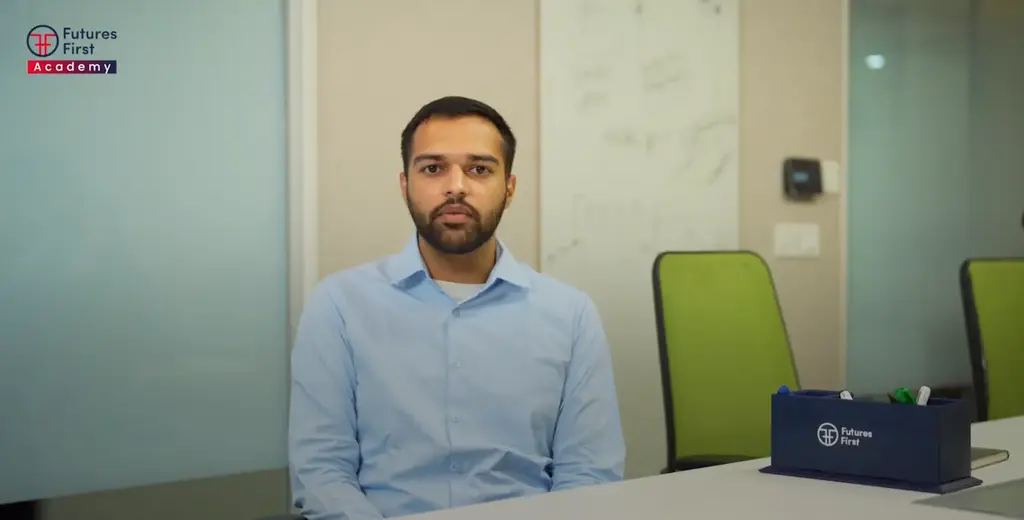
“I enrolled in the Futures First Academy course to build a strong foundation in trading and market analysis. The program enhanced my understanding of global markets, sharpened my decision-making, and improved my analytical skills. With knowledgeable trainers and a practical curriculum, it was a valuable experience that positively shaped my career.”
Arjun Kalra,
Past Student, Batch of 2024

Pricing
- Self-Paced Learning
- Online
- Premium Access
Course Fee
To enroll, make the payment using the above button. In case you face any problems, contact us at ffasupport@hertshtengroup.com.
FAQs & Support
Any discounts available for a course will be mentioned on its course page. We also offer referral discounts wherever applicable. To know more about referral benefits, just drop us an email at ffasupport@hertshtengroup.com
We don’t offer cancellations or refunds. However, the good news is that you can use your payment to defer the course and attend it at a later date.
Don’t worry, your payment will stay safe with us and be applied to the course when you attend it. You can defer your course for up to 6 months. If a deferment isn’t requested within this time, unfortunately the payment can’t be refunded or moved to a future course.
Our payment partner is Razorpay, and you can view all available payment methods directly on the payment page. At present, we accept payments in a single lump sum.
 ">
">